We have compiled a list of manufacturers, distributors, product information, reference prices, and rankings for Dissimilar metal joining technology.
ipros is IPROS GMS IPROS One of the largest technical database sites in Japan that collects information on.

Dissimilar metal joining technology - List of Manufacturers, Suppliers, Companies and Products

Dissimilar metal joining technology Product List

1~6 item / All 6 items

Displayed results

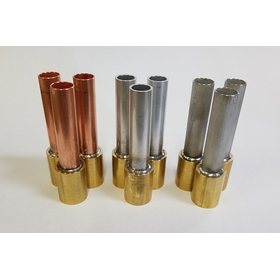
Friction Welding

Balancing durability and cost! A dissimilar metal joining technology that meets the demands of new product development.

"Friction welding technology" is a technique that utilizes the thermal energy generated by friction and strong pressure, enabling the joining of dissimilar metals and non-ferrous metals that are very difficult to join using conventional welding techniques. While durable materials tend to be expensive, it is possible to use durable materials only where necessary and cheaper materials elsewhere, allowing for the provision of joining materials that balance durability and cost. Our company has a proven track record in applications such as electronic components like copy rollers and motor shafts, as well as mechanical parts. [Features] - Balancing durability and cost - Combination of different properties - Provision of "titanium-heat-resistant steel" joining materials that balance corrosion resistance and heat resistance - Proven applications in electronic components and mechanical parts *For more details, please refer to the PDF document or feel free to contact us.

  • Processing Contract

Added to bookmarks

Bookmarks list

Bookmark has been removed

Bookmarks list

You can't add any more bookmarks

By registering as a member, you can increase the number of bookmarks you can save and organize them with labels.

Free membership registration

Tohoku University Technology: Joining of Solid Metals: T24-079

It is possible to strongly bond phase-separated metals that could not be traditionally metallurgically joined while maintaining the shape of the components.

The technology for joining dissimilar metals is expected to contribute to weight reduction of vehicles such as automobiles, railways, and aircraft, improving safety and speed performance, as well as reducing CO2 emissions through lightweighting. However, depending on the types of metals, compatibility issues can arise, leading to phase separation and making joining difficult. The inventors developed a method for joining incompatible metals, such as Fe and Mg, using the de-alloying method as described in Patent No. 6710707. By pre-diffusion bonding an Fe-Ni intermediate layer to the tip of the Fe, and then heating the Fe-Ni intermediate layer in contact with Mg, de-alloying occurred. Only Ni was de-alloyed from the intermediate layer to the Mg side, and Mg filled the gaps in the porous structure of Fe, resulting in a composite structure where Fe and Mg were intertwined at the joint interface, achieving a strong Fe-Mg mechanical bond. Additionally, by utilizing the decrease in melting temperature associated with the Mg-Ni alloy reaction, the joint interface could be liquefied while maintaining the shape of the joined materials, thereby promoting de-alloying. At the same time, pressure was continuously applied to expel the alloy liquid, which becomes brittle upon solidification, to the outside.

Added to bookmarks

Bookmarks list

Bookmark has been removed

Bookmarks list

You can't add any more bookmarks

By registering as a member, you can increase the number of bookmarks you can save and organize them with labels.

Free membership registration

Laser-based dissimilar metal joining technology

Composite of high-performance materials 'Multi-Material' - Proposing fusion bonding technology between different metals.

Joining technologies that replace bolt, rivet, and clinch fastening Main benefits: ■ Weight reduction ■ Reduction in the number of parts ■ Reduction in manufacturing hours ■ Flexibility for new designs ■ Local reinforcement, non-magnetic, biocompatibility, corrosion resistance, hardening, etc. *For more details, please refer to the catalog or feel free to contact us.

Added to bookmarks

Bookmarks list

Bookmark has been removed

Bookmarks list

You can't add any more bookmarks

By registering as a member, you can increase the number of bookmarks you can save and organize them with labels.

Free membership registration

Related Categories of Dissimilar metal joining technology